 The subfossil remains found on the spur Thighed Tortoise (Testudo Graeca), dating between 35,000 and 150,000 years, would confirm the indigenous character of the species in the southeastern Iberian, contrary to what happens in Mallorca (small area in southwestern island), which appear to have been introduced from North Africa.
Morphology Thighed Tortoise
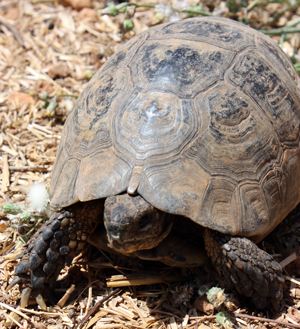
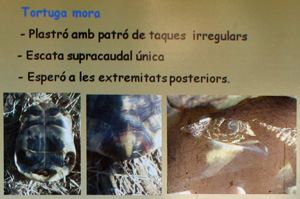
The Testudo Graeca, differs from the Hermanni’s Tortoise to have at the tip of the tail a kind of nail missing from T. graeca, in the turtle dwells underwings shield is not divided into two (above the tail), its color is darker, has a horn-like spurs characteristic tubercles on the sides of the rear legs has the plastron or wahoo (belly animal) with irregular black spots and lives in Southwest Majorca.
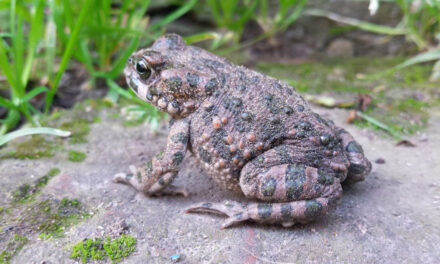
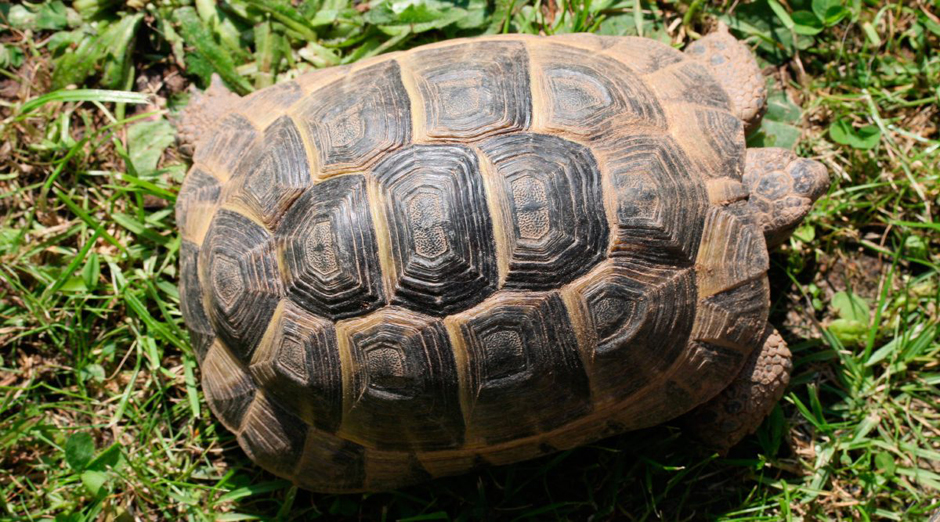
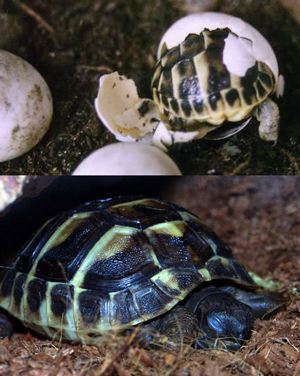
This turtle can grow to 30 cm long, has a pretty domed carapace, light brown with black spots. The plastron is also less or more clear with black spots, as each copy. The legs and head are brown too. In the forelimbs are seen some fairly large, hard scales, whereas in the hind limbs are considerably smaller scales. The nails are also quite strong and resilient, have 5 claws on the forefeet and 4 in the rear.
Senses
The turtles have an excellent view: know how to distinguish shapes and colors and can even recognize people. They have a sense of direction very accurate, if they are moving a few hundred yards of territory on which they are returning soon. They are very sensitive to vibration of the earth but do not have a developed ear. Instead, the smell is well developed and play an important role in finding food and sexual partners.
Habitat Thighed Tortoise
The Testudo Graeca turtle population is limited dwells in the west of Mallorca.
Turtles prefer areas of low slope, steppe vegetation, with bushes and shrubs, small size, typical of Mediterranean vegetation.
In some areas reach densities found above 10 turtles per hectare, the average no more than 5 specimens, and in many places is only one copy per hectare.
Inactivity
Turtles are ectotherms animals, reduce its activity almost completely during the winter period. Burrow for hibernation in humid and sheltered areas. Hibernation is a vital metabolic phase of this species, and the only thing that can prevent a disease or other debilitating circumstances. For the adult hibernation is essential.
They leave this lethargy in early March, when the temperature reaches 20 degrees C., its activity increases progressively with temperature.
Breeding and feeding Thighed Tortoise
Females take longer to reach sexual maturity, so they grow more during his youth and are larger. The overalls of the males is concave to facilitate copulation.
From May to June, as a rule, each female deposited in small holes between 3 and 7 eggs (the number varies according to height and age), with an average of 33.21 x 26.84 mm. Each female can produce several posts each season. Incubation lasts between the months of July, August and September. The turtles are born in late August or early September.
This is basically a vegetarian species. It feeds with wild plants (dandelions, thistle, hedge mustard, clover, etc..) But also feeds on berries and fruits, and very occasionally, carrion or meat from shells.
Behavior
It’s a very territorial animal. In summer are usually active in the morning and afternoon, and take refuge in the midday heat in their caves. In spring and autumn will be active from mid-morning until evening begin.
Their predators are usually rats, cats, gulls, etc..
Extinction
The animal is particularly protected by law as being in serious danger of extinction. At present there are only 3 populations in our country, 2 in the south of the peninsula and 1 residual in Mallorca. The Testudo Graeca turtle is then in default risk in the Iberian Peninsula.
Legislation
* Possession of the Testudo Graeca turtle/ Thighed Tortoise is penalized by heavy fines.
If you find an injured turtle victim of accident, we must take it to the local police or call 971 176 800 – 971 144 107 (COFIB).
If you find a turtle release, it is recommended not catch it or take it to a reintroduction center, as if we are removing animals from the already small population, we are only working with extinction.
Has been classified as special interest by both national law and autonomous.
It is included in II Appendix of CITES. Appears in the Atlas and Red Data Book of amphibians and reptiles of Spain.
Vulnerable (VU): Category for species considered at high risk of extinction in the wild.
So that is absolutely prohibited the capture of wild specimens.